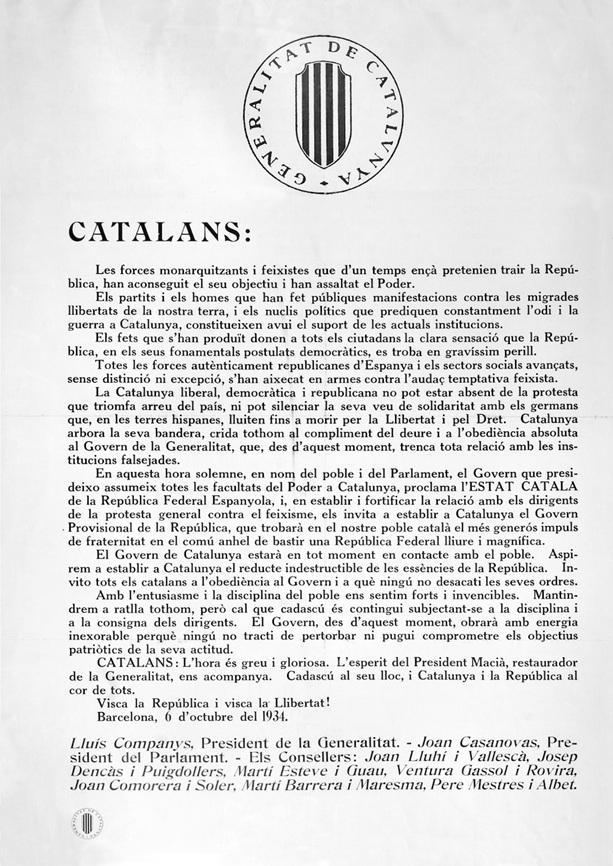
Proclamation of the Catalan state. Generalitat of Catalonia, 6th October 1934
Cataloguing Data
Period / Epoch
6 October 1934
Original title
Proclamació de l’Estat Català. Generalitat de Catalunya, 6 d’octubre de 1934
Category
Speech, proclamation
Description
The proclamation, on 14th April 1931, of the Catalan Republic, transformed shortly afterwards into the Generalitat of Catalonia, opened a period of constitutional reform in the Principality on which the juridical structure of the new Catalan autonomy within the Second Spanish Republic was built. In September 1932, the Statute of Catalonia was approved and in November the Parliament of Catalonia was elected. The Catalan party, Esquerra Republicana, a group representing the popular classes, was consolidated as a leading party. Elections in November 1933 resulted in a swing towards conservatism in the Spanish Parliament. As a consequence, the centre-right (which was openly hostile to the devolved autonomy model and the demands of the popular classes) gained access to centralised power. This led to a conflict between the Catalan and Spanish governments.
Original language
Catalan
Date
6 Oct 1934
Author(s)
Lluís Companys i Jover, Joan Casanovas i Maristany, Joan Lluhí i Vallescà, Josep Dencàs i Puigdollers, Martí Esteve i Guau, Ventura (Bonaventura) Gassol i Rovira, Joan Comorera i Soler, Martí Barrera i Maresma, Pere Mestres i Albet
| In October 1934, there was a shift towards a more conservative and even a more fascist leaning government in the Spanish state. People came to power who were antagonistic to the basic principles of the Second Spanish Republic. This generated a revolutionary spirit across the entire state, which would have its maximum expression in Asturias and Catalonia. In the case of Catalonia, on the 6th, the regional government, the Generalitat of Catalonia proclaimed a Catalan State within the Federal Spanish Republic. The initiative failed due to a lack of popular support and the loyalty of the Army to the centralised government of the Republic. The subsequent repression led to the detention of 30,000 militants and leaders of left-wing parties, which included Lluis Companys, president of the Generalitat of Catalonia and his government. Political centres were closed, newspapers were suppressed, there were evictions of agricultural workers and the Statute of Catalonia was annulled until the electoral triumph of the Front Popular (Popular Front) in February 1936.
|