Nationalist Assembly of Lugo Manifesto
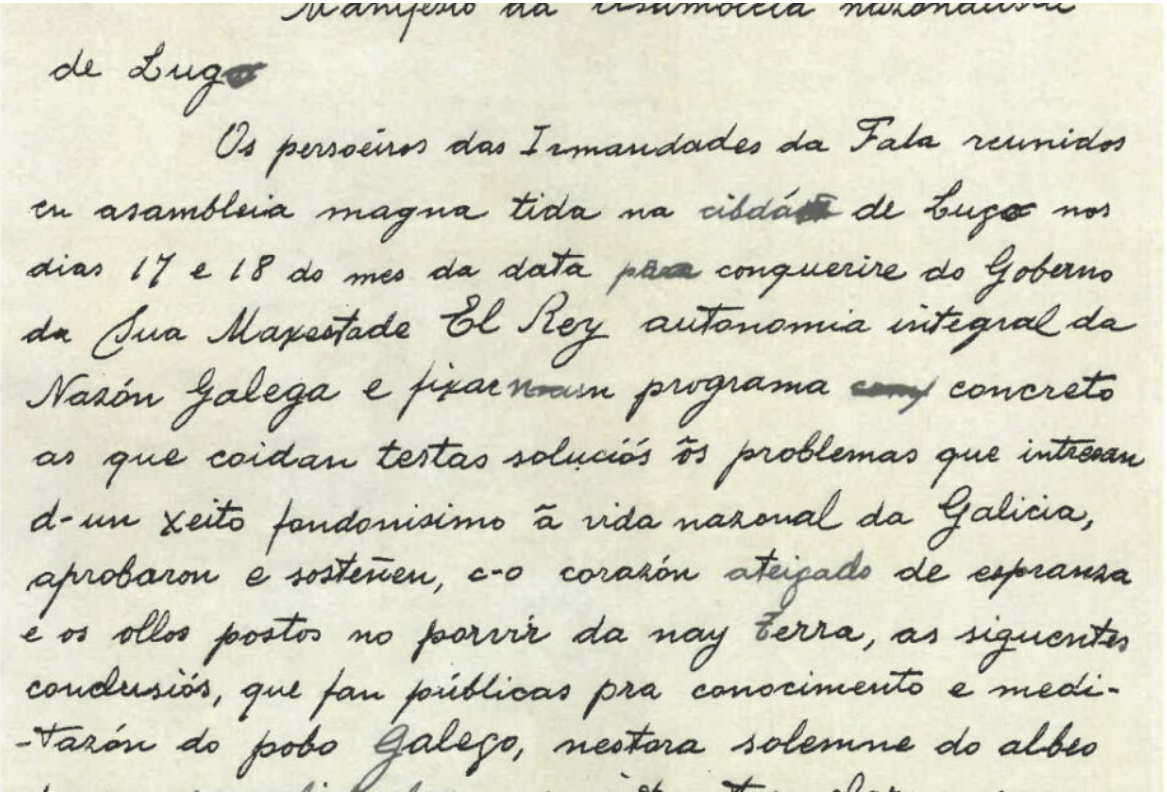
Cataloguing Data
Period / Epoch
18 November 1918
Original title
Manifesto da Asemblea Nazonalista de Lugo
Category
Policy proposal
Description
The slow progression of political Galician nationalism in the 19th and early 20th centuries took a decisive leap forward in 1916 with the appearance of the Irmandades da Fala (Brotherhood of the Language), which brought together regionalists from a variety of backgrounds. The consolidation of the Irmandades, which were explicitly defined as nationalist, took place at the 1st Nationalist Assembly of Lugo, which approved the Manifesto outlining the Galician nationalist movement’s political proposals. This foundational Manifesto owes its importance to its serving as the common basis for all nationalist programmes until the Second Republic.
Original language
Galician
Date
Nov 1918
Author(s)
Antón Losada Diéguez, Antón Villar Ponte, Lois Peña Novo, Manuel Banet Fontenla, Xaime (Jaime) Quintanilla Martínez, Ramón Cabanillas Enríquez, Alfonso Manuel Rodríguez Castelao (Castelao), Victoriano Taibo García, Gonzalo Francisco López Abente, Guillermo Cedrón Gómez, Xesús Culebras Rodríguez
The Manifesto takes the form of a programmatic political document whose subject is the Galician people, addressed to the Head of the Spanish State. The document’s central demand is political, economic and financial autonomy for Galicia within the framework of a federation of Iberian nations, including Portugal.
The Manifesto is divided into seven sections structuring the political and institutional framework of the federal state of Galicia, administrative reform, the powers of the Galician government, the legal framework, the economy and cultural, artistic and land management matters. The text recognises the legal personality of parishes, which are endowed with a management and government structure; establishes an electoral system based on proportional representation; demands co-official status for Galician and Castilian Spanish; recognises gender equality; dissolves the provincial councils; establishes an autonomous tax system; delegates certain powers, such as customs and excise, to the Federal State on the basis of a bilateral agreement; and highlights the need to draft a law to harmonise buildings with traditional local styles of construction.